CloudFront Finally Has Tag-Based Cache Invalidation
In April 2026, AWS announced that CloudFront can invalidate cached objects by cache tag. Before that, you either tracked URLs yourself or built a small distributed system: in the AWS reference architecture, that meant Lambda@Edge, SNS, SQS, DynamoDB, Lambda workers, Step Functions, IAM, CDK, and cleanup logic.
It made sense at the time. It was also a lot of machinery for a cache purge problem.
Why Was URL-Based Cache Invalidation the Wrong Abstraction?
In 2026, AWS described cache tag invalidation as a way to remove groups of related content with a single request (AWS announcement, 2026). That's the right abstraction because most application changes map to entities, not URLs.
A product price changes, and suddenly you need to refresh the product detail page, category pages, sale pages, search landing pages, recommendations, Open Graph images, and maybe a few server-rendered fragments. An author profile changes, and every article written by that author that might need a new byline.
URL invalidation asks the application to know every representation of that entity, and cache tags let the application say what the response depends on - that is the useful shift. Instead of asking, "which paths should I purge?", you can ask "what changed?" and If product-123 changed, purge product-123. Every cached response that declared that dependency can be evicted together.
Cache tags are not just an invalidation feature. They are a dependency model for the CDN. Once you see them that way, path-based purging starts to look like a leaky implementation detail.
How Did Other CDNs Make Cache Tags Feel Normal?
Cloudflare documents cache-tag purging as a five-step workflow: add a Cache-Tag response header, let Cloudflare associate tags with cached content, then purge matching tags through the dashboard or API (Cloudflare Docs, retrieved 2026). Netlify supports a similar model using Cache-Tag, Netlify-Cache-Tag, and cache purge APIs.
CloudFront is not inventing this model. It is catching up to a pattern web developers already expect from other CDN platforms.
Cloudflare supports purging by cache tag using the Cache-Tag response header. Your origin returns something like this:
Cache-Tag: product-123,category-shoes,tenant-acmeCloudflare associates those tags with the cached object. Later, you purge a tag through the dashboard or API, and Cloudflare removes every matching cached object.
Netlify supports the same broad idea. You can set Cache-Tag or Netlify-Cache-Tag, then purge by tag through a function helper or API. Netlify also connects this to its deploy model with Netlify-Cache-ID, which can register cache IDs as purgeable tags.
| CDN | How cache tags are attached | How tagged content is purged |
|---|---|---|
| CloudFront | Configured response header with comma-separated tag values | CloudFront invalidation request by cache tag |
| Cloudflare | Cache-Tag response header | Dashboard or API purge by tag |
| Netlify | Cache-Tag or Netlify-Cache-Tag response header | purgeCache helper or purge API by tag |
The details differ between providers, but the mental model is the same: attach cache metadata to the response, then invalidate by that metadata later.
What Did CloudFront Tag Invalidation Require Before?
In May 2026, the AWS reference architecture for tag-based invalidation in CloudFront was updated to say native cache-tag invalidation should be used for new builds (AWS Networking Blog, 2026). The older solution worked, but it required two workflows: one to ingest tag mappings and one to turn tags back into path invalidations.
Before native cache-tag invalidation, AWS had a reference architecture for tag-based invalidation in CloudFront. It was clever, but it was not small.
The old pattern had two main workflows.
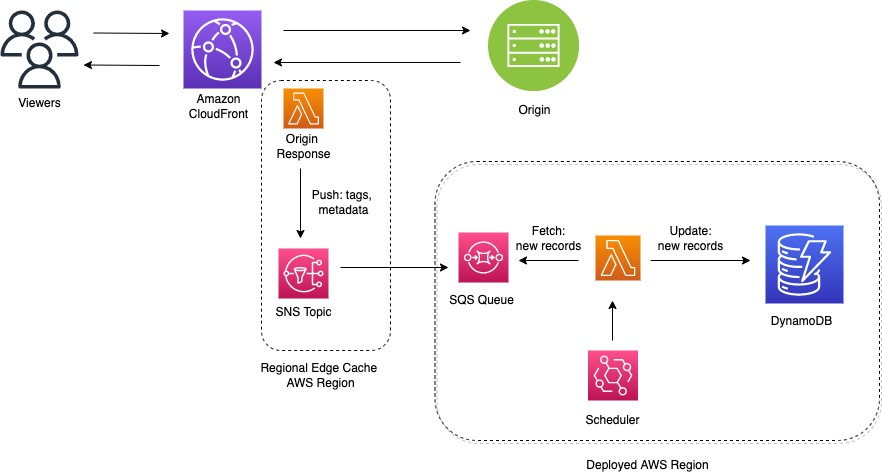
First, a tag ingestion workflow captured response headers from the origin. A Lambda@Edge function ran on origin responses, extracted a custom tag header, removed that header, and sent the URL-to-tag mapping into regional messaging infrastructure. From there, messages flowed through SNS, SQS, scheduled Lambda functions, and finally into DynamoDB.
Second, a tag invalidation workflow handled purge requests. A user submitted tags to a Step Functions workflow. The workflow looked up matching URLs in DynamoDB, deduplicated them, queued purge work, and submitted CloudFront path invalidations while respecting CloudFront invalidation limits.
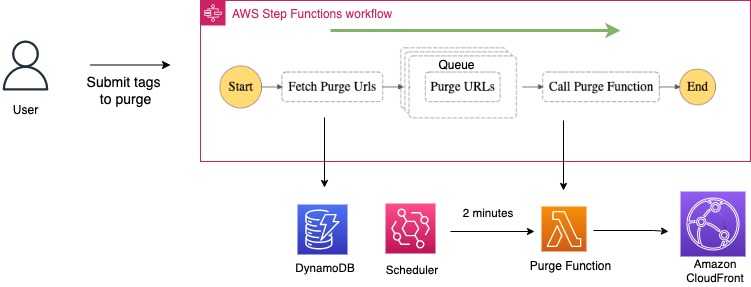
That meant tag-based invalidation needed:
- Lambda@Edge code deployed in
us-east-1 - regional SNS topics
- SQS queues
- scheduled Lambda workers
- DynamoDB tables
- Step Functions orchestration
- IAM policies
- CDK deployment machinery
- cleanup logic
- monitoring and failure handling
| Concern | Old reference architecture | Native CloudFront cache tags |
|---|---|---|
| Tag capture | Lambda@Edge intercepts origin responses | CloudFront reads configured response header |
| Tag storage | DynamoDB mapping table | Associated with cached objects by CloudFront |
| Invalidation orchestration | Step Functions plus Lambda workers | CloudFront invalidation by tag |
| Operational ownership | You own queues, tables, functions, IAM, cleanup | You own tag design and invalidation calls |
That is a lot of operational surface area for something that other CDNs exposed as a cache primitive. The AWS post now says that if you're starting fresh, use the native feature instead of the reference solution. That is the right recommendation.
What Changed in CloudFront?
In 2026, CloudFront added native invalidation by cache tag. AWS says developers and site reliability engineers can tag cached objects through a specified HTTP response header, assign multiple tags per object, and invalidate all objects sharing a tag in one request (AWS announcement, 2026).
CloudFront now lets you tag cached objects when your origin returns them. You include a configured response header containing comma-separated tag values. CloudFront associates those tags with the cached object. Later, you submit an invalidation request by cache tag, and CloudFront invalidates the related objects.
AWS describes the feature as useful for product updates, legal takedown requests, regulatory compliance requests, and multi-tenant platforms.
That matters because those are exactly the cases where path-based invalidation is awkward. Related content often lives across unrelated URLs. A legal takedown might affect pages, images, listing routes, search pages, and static derivatives. A tenant update might touch every route under a brand, but not necessarily under one path prefix.
The announcement also gives useful propagation numbers. AWS says CloudFront invalidations currently take effect in under 5 seconds at P95, with end-to-end completion status reported in under 25 seconds at P95.
That doesn't make cache invalidation instant. It does make the native path much easier to reason about than a custom invalidation pipeline you have to operate yourself.
Why Is Response-Level Cache Metadata Better Architecture?
The old CloudFront workaround externalized cache metadata into your own infrastructure across Lambda@Edge, SNS, SQS, Lambda, DynamoDB, and Step Functions (AWS Networking Blog, 2026). The native model keeps metadata with the HTTP response, where the origin can declare dependencies directly.
The origin already knows what a response depends on. If a product page depends on product-123, category-shoes, and tenant-acme, the origin can say so when it returns the response. The CDN can store that relationship with the cached object.
You no longer need to maintain a parallel database that tries to remember the same relationship.
That removes failure modes. No ingestion lag. No tag mapping table drifting from cache reality. No scheduled worker failing to drain a queue. No Step Functions execution half-succeeding. No cleanup job for stale DynamoDB records. No separate deployment lifecycle for the thing that exists only because CloudFront lacked a primitive.
The old pattern made CloudFront cache state observable only after you rebuilt it somewhere else. The new pattern lets the CDN own the relationship between cached object and cache metadata. That's a cleaner boundary.
There is still complexity, but it moves to the right place: designing good tags and emitting them consistently from the application.
What Does This Unlock for Web Apps on AWS?
AWS lists product updates, legal takedowns, regulatory compliance requests, and multi-tenant platforms as cache-tag invalidation use cases (AWS announcement, 2026). Those examples map directly to common web app workflows.
The most obvious use case is CMS-driven sites.
When an editor updates an article, the CMS can trigger a purge for article-456. That can invalidate the article page, homepage teasers, author pages, topic pages, RSS-like feeds, and any server-rendered fragments tagged with the same content dependency.
E-commerce has the same shape. A product update can purge product-123. A category promotion can purge category-running-shoes. A pricing rule can purge price-list-au. You don't need to enumerate every URL that might render that data.
Multi-tenant applications also benefit. A tenant configuration change can purge tenant-acme without touching other tenants. That is much cleaner than wildcarding broad path prefixes and hoping your URL structure maps perfectly to your data model.
It also makes ISR-style workflows less weird on AWS.
Incremental Static Regeneration became popular because it gave developers a way to mix static performance with targeted freshness. But if your AWS-hosted app needed precise CDN purging, you often ended up rebuilding framework-level ideas with edge functions and queues. Native cache tags give CloudFront a more app-shaped invalidation primitive.
This doesn't replace application-level regeneration. It complements it. Your app still needs to rebuild or refetch fresh content. CloudFront now has a cleaner way to stop serving the stale cached representations.
What Caveats Still Matter With CloudFront Cache Tags?
AWS prices each cache tag as one invalidation path, so cache-tag invalidation is not a free background wish (AWS announcement, 2026). You still need sensible tag names, bounded cardinality, correct cache keys, and a plan for short propagation windows.
Cache tags are a sharper tool, not a magic one.
You still need a tag naming strategy. If every response gets a unique tag that is never reused, you haven't gained much. If every response gets a giant shared tag, you're back to broad invalidation. Useful tags usually sit at entity boundaries: product ID, category ID, tenant ID, author ID, article ID, site section, locale, or content collection.
You also need to care about cardinality and header size. Response headers are not a database. Tags should be compact, predictable, and bounded. A page depending on three entities is fine. A page emitting thousands of tags is probably telling you the cache model is wrong.
Invalidation cost and quotas still matter too. AWS says each cache tag is priced as one path. That is a good reminder that tag invalidation is still CloudFront invalidation. Use it for meaningful freshness events, not as a substitute for sensible TTLs and Cache-Control.
Propagation is fast, but not synchronous. AWS's P95 numbers are strong, but your application should still tolerate short windows where some edge locations may serve stale content. That is normal CDN behavior. Design user experiences and operational workflows with that in mind.
Finally, tags do not save you from bad cache semantics. If your response varies by cookie, authorization, locale, device, or query parameter, the cache key still needs to be correct. Tags answer "what should be purged together?" They don't answer "is this response safe to cache?"
The Takeaway
CloudFront native cache-tag invalidation is useful because it deletes plumbing. The old AWS reference architecture required Lambda@Edge, messaging, DynamoDB, orchestration, and workers. The new feature collapses most of that into a response header and a native invalidation request.
The old AWS reference architecture was a reasonable workaround for a missing CDN primitive. But it required a surprising amount of infrastructure: Lambda@Edge to read tags, messaging to move them, DynamoDB to remember mappings, Step Functions to orchestrate invalidations, and Lambda workers to submit path purges safely.
That work can now collapse into a response header and a native invalidation request.
CloudFront did not invent tag-based invalidation. Cloudflare, Netlify, and other CDN platforms have already made developers expect this kind of control. The important change is that AWS-hosted web apps no longer need to build and operate a sidecar invalidation system to get it.
That is the best kind of cloud feature: the one that lets you delete code, delete infrastructure, and explain the architecture in fewer boxes.
But if you really want to build fast, cache-friendly web applications on AWS, you need more than one good CloudFront feature. You need a team that understands how to design the application, CDN, and operational model together.
That's where Mechanical Rock comes in. We help teams architect and build production-ready cloud applications that balance performance, cost, and operational simplicity. Get in touch if you want to discuss how we can help your team ship better web platforms on AWS.
Frequently asked questions
CloudFront cache-tag invalidation lets an origin attach tag values to cached responses, then invalidate all cached objects sharing a tag. In 2026, AWS said this supports grouped purges for workflows like product updates, legal takedowns, compliance requests, and multi-tenant content refreshes.
No. AWS says CloudFront invalidations currently take effect in under 5 seconds at P95, with end-to-end completion status reported in under 25 seconds at P95. That's fast for CDN invalidation, but applications should still tolerate brief stale-cache windows.
For new builds, yes. AWS updated its earlier tag-based invalidation reference architecture to recommend the native CloudFront feature instead. Existing systems may still need migration planning, but new systems should avoid the Lambda@Edge, DynamoDB, SQS, SNS, and Step Functions workaround.
The mental model is similar: attach tags through response headers, then purge by tag later. Cloudflare uses `Cache-Tag`, while Netlify supports `Cache-Tag` and `Netlify-Cache-Tag`. CloudFront now brings that same response-metadata pattern into AWS-native CDN workflows.